
1. Receipt (acceptance) of equipment
You have just received the oven. Before starting installation and placement, carefully read this manual. The oven you received was manufactured under the close supervision of our specialists. Upon receipt, make sure the equipment is intact and handle it with care.
For this, it is necessary to provide effective unloading and placement means, with a capacity corresponding to the oven’s weight (see section «Weight and dimensions»).
During transportation, the oven is supplied separately from the support base because the oven’s center of gravity is shifted upwards. Transporting the oven together with the support base may lead to dangerous situations and equipment damage.
When unpacking the oven, it is necessary to remove the wooden beams and attach it to two auxiliary elements of the support base, which allow moving the oven using a trolley – lift and a transport platform. The aforementioned support base, whose auxiliary elements are called "front stand," is packed separately.
The stands are equipped with bolts and fastening nuts, which must be secured after removing the wooden blocks that support the oven during transportation.
The oven must be positioned by specialists without endangering their life and health!
During this operation, it is strictly forbidden to stay under the equipment in its suspended state.
The oven must be attached to the provided stands, which allow moving it within the premises using a transport platform. The oven should be carefully lifted to a small height, sufficient for relocation.
Lifting and moving the oven without following the required safety measures may cause it to fall. The oven’s center of gravity is shifted upwards.
Attention! Tilting the equipment onto its side is prohibited.
2. Instructions for oven placement
The oven must be installed by qualified personnel familiar with this manual, in a well
lit and ventilated room.
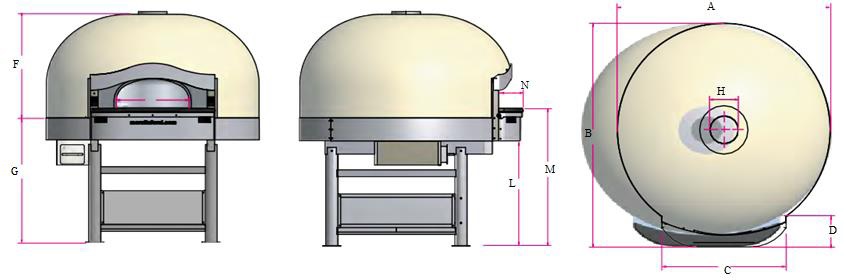
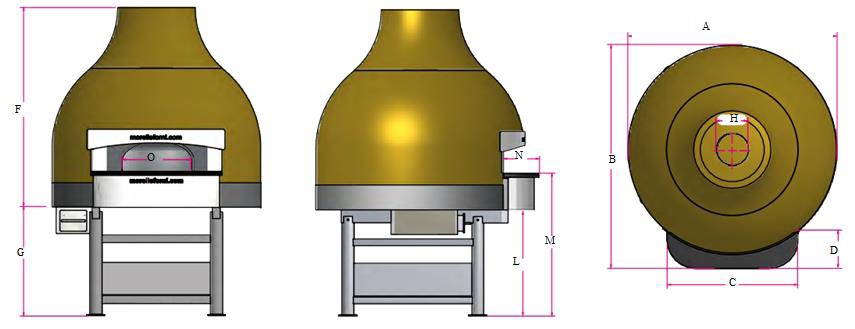
To position the oven, it needs to be lifted. The oven’s weight and dimensions are shown in the attached technical diagrams.
In the diagrams, the oven is depicted after the removal of protective packaging and plastic film.
If the transport equipment is not equipped with a lifting crane or fork attachment, a
trolley-lift must be used.
The oven must be lifted and moved carefully, avoiding sudden movements.
The lifting capacity and dimensions of the moving equipment must correspond to the oven’s weight and size.
This oven belongs to the category of ovens operating by burning solid fuel, therefore it
must be installed in a well-ventilated room, in compliance with the regulations of
the relevant authorities.
The oven does not require electrical connection to operate.
3. Range of oven models
| Vera Oven Model Range | 90 | 100 | 110 | 130 | 150 | 180 | |
| Thermal power of oven | kW | 25 | 28 | 35 | 46 | 56 | |
| Air required for combustion | m³/h | 165 | 167 | 173 | 180 | 220 | |
| Triple point value for chimney calculation according to DIN “4705” | |||||||
| Exhaust gas quantity | g/s | 120 | 128 | 148 | 175 | 215 | |
| Exhaust gas temperature | °C | 85 | 100 | 110 | 120 | 130 | |
| Required draft pressure | mbar | 0,07 | 0,07 | 0,07 | 0,07 | 0,07 | |
| Oven chimney diameter | mm | 200 | 200 | 200 | 200 | 250 | |
| Cooking surface area | m² | 0,785 | 0,950 | 1,237 | 1,766 | 2,149 | |
| Vulcan Oven Model Range | 90 | 100 | 110 | 130 | 150 | 180 | |
| Thermal power of oven | kW | 25 | 28 | 35 | 46 | 56 | |
| Air required for combustion | m³/h | 165 | 167 | 173 | 180 | 220 | |
| Triple point value for chimney calculation according to DIN “4705” | |||||||
| Exhaust gas quantity | g/s | 120 | 128 | 148 | 175 | 215 | |
| Exhaust gas temperature | °C | 85 | 100 | 110 | 120 | 130 | |
| Required draft pressure | mbar | 0,07 | 0,07 | 0,07 | 0,07 | 0,07 | |
| Oven chimney diameter | mm | 200 | 200 | 200 | 200 | 250 | |
| Cooking surface area | m² | 0,785 | 0,950 | 1,237 | 1,766 | 2,149 | |
4. Weight and Dimensions
4.1. Mario Model
| Model | Specifications |
| Mario100 | Inner diameter 1000 mm, Outer diameter 1500 mm, Height with stand 1900 mm. Chimney diameter – 250 mm. Simultaneous pizza loading capacity: 3 pcs of 300 mm. Productivity: 35 pizzas per hour. Weight: 1500 kg Dome material: fire-resistant brick, thermal insulation, Bottom hearth material: chamotte brick grade ША-9 Stand with firewood shelf: black metal. |
| Mario 120 | Inner diameter 1200 mm, Outer diameter 1700 mm, Height with stand 1900 mm. Chimney diameter – 250 mm. Simultaneous pizza loading capacity: 6 pcs of 300 mm. Productivity: 75 pizzas per hour. Weight: 1700 kg Dome material: fire-resistant brick, thermal insulation, Bottom hearth material: chamotte brick grade ША-9 Stand with firewood shelf: black metal. |
| Mario 130 | Inner diameter 1300 mm, Outer diameter 1800 mm, Height with stand 1900 mm. Chimney diameter – 250 mm. Simultaneous pizza loading capacity: 10 pcs of 300 mm. Productivity: 125 pizzas per hour. Weight: 1800 kg Dome material: fire-resistant brick, thermal insulation, Bottom hearth material: chamotte brick grade ША-9 Stand with firewood shelf: black metal. |
| Mario 140 | Inner diameter 1400 mm, Outer diameter 1900 mm, Height with stand 1900 mm. Chimney diameter – 250 mm. Simultaneous pizza loading capacity: 12 pcs of 300 mm. Productivity: 150 pizzas per hour. Weight: 2000 kg Dome material: fire-resistant brick, thermal insulation, Bottom hearth material: chamotte brick grade ША-9 Stand with firewood shelf: black metal. |
| Additional Options |
Damper Thermometer Shelf made of natural granite, stainless steel bracket under the window sill Painting of metal parts in a color other than black Decorative stainless steel overlay above the arch Set of brackets for crane unloading Inscription/logo made of mosaic Stainless steel logo stencil |
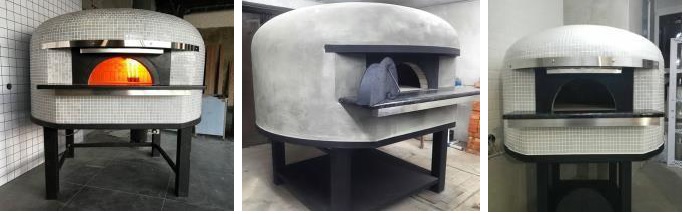
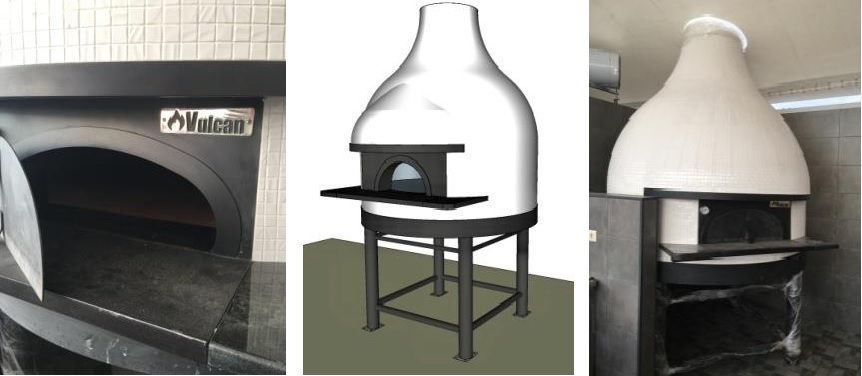
4.2 Vulcan Model
| Model | Specifications |
| Vulcan90 | Outer diameter: 1500 mm, Inner diameter: 900 mm Number of pizzas Ø30 cm: 2 pcs. Weight: 1900 kg Mouth 440x220 - 540x220 mm. Chimney diameter: 250 mm. Hearth height from floor: 1150 mm. Total height: 2850 mm Standard wall thickness: 150-200 mm. Minimum wall thickness: 150 mm Hearth thickness: 250 mm |
| Vulcan 100 | Outer diameter: 1600 mm, Inner diameter: 1000 mm Number of pizzas Ø30 cm: 3 pcs. Weight: 2200 kg Mouth 440x220 - 540x220 mm. Chimney diameter: 250 mm. Hearth height from floor: 1150 mm. Total height: 2850 mm Standard wall thickness: 150-200 mm. Minimum wall thickness: 150 mm Hearth thickness: 250 mm |
| Vulcan 120 | Outer diameter: 1800 mm, Inner diameter: 1200 mm Number of pizzas Ø30 cm: 5 pcs. Weight: 2400 kg Mouth 440x220 - 540x220 mm. Chimney diameter: 250 mm. Hearth height from floor: 1150 mm. Total height: 2850 mm Standard wall thickness: 150-200 mm. Minimum wall thickness: 150 mm Hearth thickness: 250 mm |
| Vulcan 130 | Outer diameter: 1900 mm, Inner diameter: 1300 mm Number of pizzas Ø30 cm: 8 pcs. Weight: 2900 kg Mouth 440x220 - 540x220 mm. Chimney diameter: 250 mm. Hearth height from floor: 1150 mm. Total height: 2850 mm Standard wall thickness: 150-200 mm. Minimum wall thickness: 150 mm Hearth thickness: 250 mm |
| Vulcan 140 | Outer diameter: 2000 mm, Inner diameter: 1400 mm Number of pizzas Ø30 cm: 10 pcs. Weight: 3500 kg Mouth 440x220 - 540x220 mm. Chimney diameter: 250 mm. Hearth height from floor: 1150 mm. Total height: 2850 mm Standard wall thickness: 150-200 mm. Minimum wall thickness: 150 mm Hearth thickness: 250 mm |
| Additional options | Ash drawer Thermometer Polished stone shelf/countertop Painting of metal parts in a color other than black Plaster painting Set of brackets for crane unloading Mosaic inscription/logo |
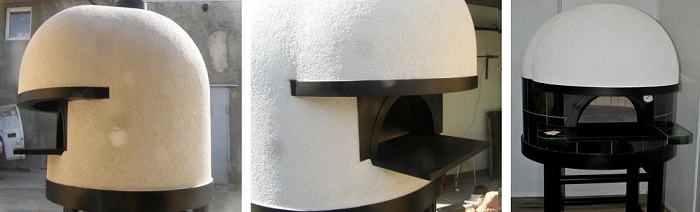
4.3 Vera Model
| Model | Specifications |
| Vera 90 | External diameter: 1300 mm, Internal diameter: 900 mm Number of pizzas Ø 30 cm: 2 pcs. Weight: 1500 kg Mouth 440x220 - 540x220 mm. Chimney diameter: 250 mm. Hearth height from floor: 1150 mm Total height: 2850 mm Standard wall thickness: 150-200 mm. Minimum wall thickness: 150 mm Hearth thickness: 250 mm |
| Vera 100 | External diameter: 1400 mm, Internal diameter: 1000 mm Number of pizzas Ø 30 cm: 3 pcs. Weight: 1700 kg Mouth 440x220 - 540x220 mm. Chimney diameter: 250 mm. Hearth height from floor: 1150 mm Total height: 2100 mm Standard wall thickness: 150-200 mm. Minimum wall thickness: 150 mm Hearth thickness: 250 mm |
| Vera 120 | External diameter: 1500 mm, Internal diameter: 1200 mm Number of pizzas Ø 30 cm: 5 pcs. Weight: 2200 kg Mouth 440x220 - 540x220 mm. Chimney diameter: 250 mm. Hearth height from floor: 1150 mm Total height: 2100 mm Standard wall thickness: 150-200 mm. Minimum wall thickness: 150 mm Hearth thickness: 250 mm |
| Vera 130 | External diameter: 1700 mm, Internal diameter: 1300 mm Number of pizzas Ø 30 cm: 8 pcs. Weight: 2500 kg Mouth 440x220 - 540x220 mm. Chimney diameter: 250 mm. Hearth height from floor: 1150 mm Total height: 2100 mm Standard wall thickness: 150-200 mm. Minimum wall thickness: 150 mm Hearth thickness: 250 mm |
| Vera 140 | External diameter: 1800 mm, Internal diameter: 1400 mm Number of pizzas Ø 30 cm: 10 pcs. Weight: 2900 kg Mouth 440x220 - 540x220 mm. Chimney diameter: 250 mm. Hearth height from floor: 1150 mm Total height: 2100 mm Standard wall thickness: 150-200 mm. Minimum wall thickness: 150 mm Hearth thickness: 250 mm |
| Additional options | Ash drawer Thermometer Shelf/countertop made of polished stone Painting of metal parts in a color other than black Plaster painting Set of brackets for crane unloading Inscription/logo in mosaic |
5. Description of Exterior Finish
The exterior finish of the oven can be made using various materials, except for the front control panel and other parts of the equipment required for maintenance.
Please review the following types of finishes: Structural heat-resistant paint, ceramic mosaic, plaster for further design execution by the client. For technical specification approval, please contact us for additional information.
6. Wood-Fired Oven User Manual
ATTENTION!!! IN ACCORDANCE WITH SAFETY STANDARDS REGULATING ATMOSPHERIC EMISSIONS AND THE REGULATIONS IN FORCE IN UKRAINE, ONLY NATURAL DRY UNTREATED WOOD (OF PROPER SIZE) MAY BE USED FOR BURNING IN THE OVEN.
THE USE OF OTHER TYPES OF WOOD (BARK, WOODWORKING WASTE, PAINTED OR CHEMICALLY TREATED WOOD) IS STRICTLY PROHIBITED.
TO ENSURE THE PROPER OPERATION OF THE OVEN, IT IS RECOMMENDED TO USE LOGS OR PIECES OF NATURAL WOOD, WITH A SIZE NOT EXCEEDING 40/50 CM IN LENGTH AND 15.
7. Stages of Preheating the Oven
The oven you are about to use belongs to the family of direct-burning ovens with a heavy construction.
This means that the main heat source, which provides cooking, is located in the cooking chamber, which has a heavy mass, as it is entirely made of refractory stone. The wood flame in the cooking chamber must remain within the barrier, preventing the fall of coal and ash particles.
The initial oven heating procedure must be carried out gradually.
Since the new oven contains some moisture retained in the body during manufacturing, it is necessary to gradually heat the oven from room temperature to 250-300°C (dome temperature) over more than 24 hours.
Cooking at this stage is prohibited, as the oven neutralizes odors and particles left after equipment production.
During this phase, the oven generates a significant amount of steam, so it is necessary to ventilate the room where the equipment is installed to avoid condensation. This precaution should be observed for the first 3-4 days.
Pay attention to electrical systems and connections sensitive to condensation and steam, as well as materials that could damage property or harm staff health.
Condensation formation and its drainage onto the floor along the outer sides of the oven walls is normal. Drainage must be provided to prevent hazards, accidents, or damage to surrounding objects.
WARNING: DO NOT USE FLAMMABLE SUBSTANCES IN ANY FORM, LIQUID OR SOLID, SUCH AS ALCOHOL, GASOLINE, COAL, ETC., WHEN IGNITING THE FIRE.
When lighting the oven, maintain a constant flame, not exceeding the recommended hourly wood consumption of 15 kg (considering average hourly consumption of 5-10 kg).
The oven thermometer measures the temperature inside the cooking chamber. Increasing flame intensity should never exceed 450°C.
For cooking without a flame, preheat the oven to a temperature 50° higher than required, wait for the flame to die out, then place the food in the chamber and close the removable doors.
After finishing use, wait for the flame to go out and close the chamber doors to maintain temperature until the next cycle.
8. Safety Measures
After proper installation by a qualified specialist and functional testing, the oven is ready for use.
Personnel authorized to operate the equipment must familiarize themselves with this manual for safe and independent use.
The oven operation process must be supervised by working personnel.
Removable oven doors should be placed at a short distance from the operator's position for quick shutdown if necessary.
Firefighting equipment suitable for the room should be placed near the oven in case the flame spreads beyond the combustion chamber. Use natural stone, ceramic tiles, or heat-resistant and non-combustible materials. If non-fireproof materials are nearby, maintain at least a 10 cm distance.
UNDER NO CIRCUMSTANCES use a fire extinguisher to put out the flame inside the oven!
9. Recommendations for Chimney Calculations
The design of engineering ventilation systems related to smoke removal should comply with the norms and regulations of current Ukrainian legislation.
The oven is connected to the flue using chimneys, which must meet the following requirements:
- Chimneys must be made of materials capable of withstanding flue gas temperatures (approximately 100–110°C) and possible deposits;
Joints must be well sealed with materials resistant to heat and corrosion; - Chimneys must be clearly visible, easy to disassemble and assemble, and allow for thermal expansion;
- At the oven outlet, a vertical chimney section must be installed, with a length at least twice the diameter of the flue opening;
- After the vertical section, a horizontal section can be installed with a slope of at least 3%. The length of this section should not exceed the useful height of the chimney;
- The direction may be changed in no more than three points, including the entry into the chimney;
- The bending angle must not be less than 110°;
- The cross-section of the chimney must remain constant along its entire length;
- The draft force in the chimney should be within 12–30 Pa;
- Air flow should not exceed 300–450 m³.
10. Oven Cleaning
Before turning on the oven, the combustion area must be cleaned of ash using the designated oven shovel.
To clean the cooking surface, use a specially designed brush.
If food falls onto the cooking surface, it should be removed as much as possible using the oven shovel, then allow the residue to dry and remove it after a few minutes with a brush.
Do not use water or other liquids, or cloths wet with water, to clean the cooking surface. At cooking temperatures, odors from previous cooking processes are neutralized.
Cleaning of the oven’s external surfaces should be done with a damp cloth without using cleaning agents.
11. Recommended Types of Wood for Use in a Wood-Fired Oven
Allowed: (if untreated): all types of deciduous trees; fruit tree logs give the most heat; hard woods such as acacia, oak, ash, beech, hornbeam, chestnut are suitable for long burning.
Not allowed: all coniferous trees and products made from them due to resin release; pellets, coal, charcoal, trees or shrubs treated with pesticides or other chemicals; painted or treated wood (e.g., stained); plywood and other wood materials pressed with adhesives and glue; use of rotten or pest-infested wood.
Important!
Any impurities burned in a wood-fired oven will inevitably contaminate the food you cook; never use the oven to burn household waste.